
Introduction: What Do We Mean by “Agentic AI”?
Imagine you hire an assistant and tell them, “Plan my trip to Tokyo — book flights, find a hotel within budget, and create a day-by-day itinerary.” A regular chatbot would just talk to you about Tokyo. An agentic AI, on the other hand, would actually go out, check flight prices, compare hotels, make decisions, and come back with a finished plan — adjusting along the way if something doesn’t work out.
That’s the core idea of agentic AI: instead of just answering questions, the AI takes actions, uses tools, makes decisions, and works toward a goal with some degree of autonomy.
Now here’s the important design question every builder eventually faces: Should one AI agent do all of this by itself, or should the work be split among several specialized agents that collaborate?
This is the Single-Agent vs Multi-Agent debate, and it’s one of the most important architectural decisions in building real-world AI systems today.
Part 1: Understanding Single-Agent Systems
What Is a Single-Agent System?
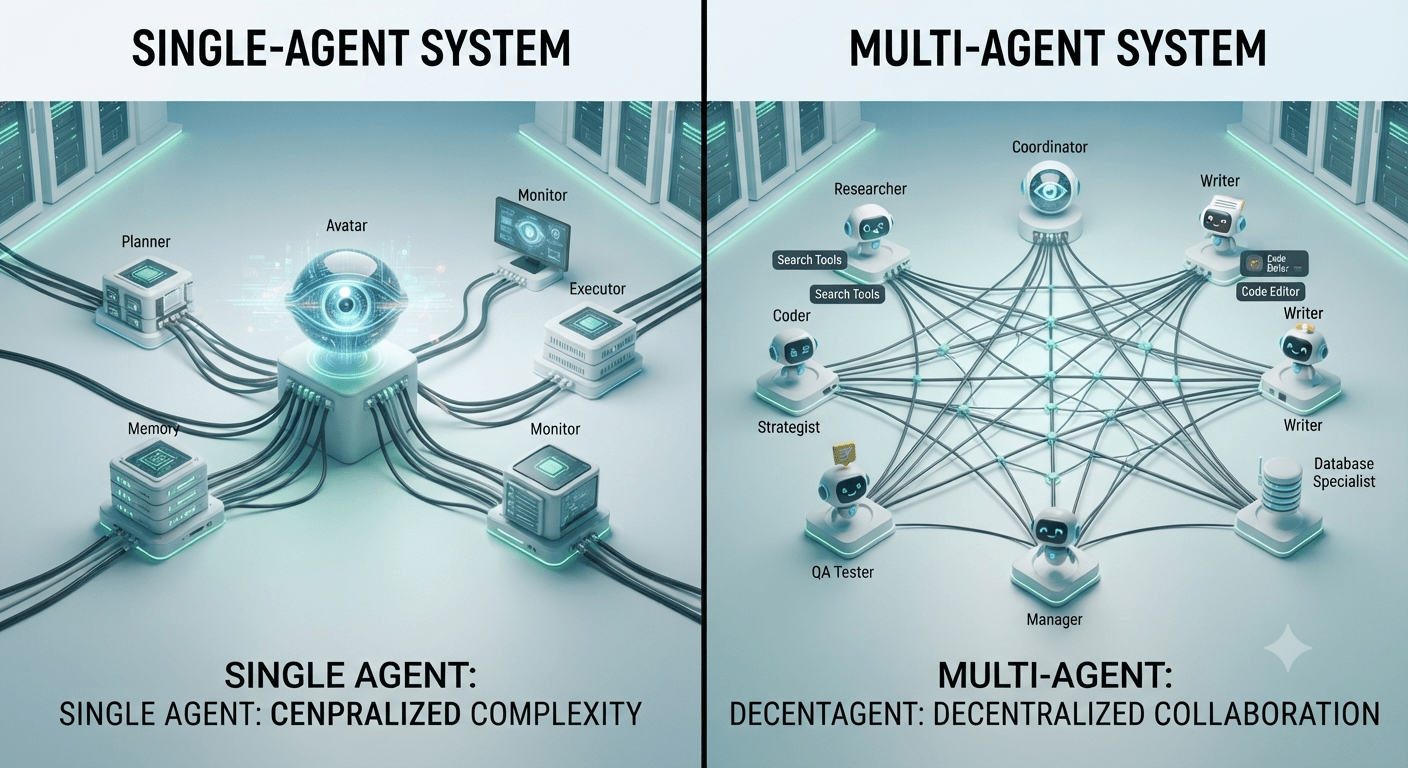
A single-agent system is exactly what it sounds like — one AI agent is responsible for understanding the task, planning the steps, using tools, and producing the final result. Think of it as a “one-person team.” That one person might be very capable — they can use a calculator, browse the internet, write code, and remember past conversations — but ultimately, one mind is doing everything.
How It Works (In Simple Terms)
A typical single-agent loop looks like this:
- Perceive – The agent reads the user’s request and any relevant context.
- Plan – It decides what steps are needed to complete the task.
- Act – It uses tools (search the web, run code, call an API) to execute those steps.
- Observe – It looks at the results of its actions.
- Repeat or Finish – It either loops back to plan more steps, or delivers the final answer.
This is often called the ReAct pattern (Reason + Act), and it’s the foundation of most AI agents you interact with today, including simple coding assistants, research bots, and customer support agents.
Real-World Example
Think of a personal finance assistant agent. You ask it: “Analyze my spending last month and tell me where I can save money.”
The single agent will:
- Pull your transaction data (a tool call)
- Categorize expenses (reasoning)
- Calculate totals per category (a tool call, like running code)
- Generate a written summary with recommendations (final output)
One agent, one continuous thread of reasoning, start to finish.
Strengths of Single-Agent Systems
| Strength | Why It Matters |
|---|---|
| Simplicity | Easier to build, debug, and reason about — there’s only one “brain” to track. |
| Lower cost | Fewer AI calls overall, since there’s no back-and-forth between multiple agents. |
| Faster for simple tasks | No coordination overhead — the agent just gets on with the work. |
| Easier to control | You can more tightly constrain what one agent is allowed to do. |
| Predictable behavior | Fewer moving parts means fewer surprises. |
Weaknesses of Single-Agent Systems
| Weakness | Why It’s a Problem |
|---|---|
| Cognitive overload | One agent trying to plan, research, code, and write can lose focus or make mistakes on complex, multi-domain tasks. |
| No specialization | A “jack of all trades” agent is rarely as good as a specialist at any one task. |
| Harder to scale | As tasks grow more complex, a single agent’s prompt and context become bloated and harder to manage. |
| Single point of failure | If the one agent makes a wrong judgment early on, the whole task can go off track with nothing to catch the error. |
Part 2: Understanding Multi-Agent Systems
What Is a Multi-Agent System?
A multi-agent system (often abbreviated MAS) uses multiple AI agents that each specialize in a role, working together — much like a company with a project manager, researchers, writers, and reviewers, each doing what they’re best at.
Instead of one generalist doing everything, you get a team of specialists, coordinated to reach a shared goal.
How It Works (In Simple Terms)
A common multi-agent setup looks like this:
- Orchestrator / Manager Agent – Breaks the big task into smaller sub-tasks and decides which agent handles what.
- Specialist Agents – Each one focuses on a narrow job: a Researcher agent gathers information, a Coder agent writes scripts, a Reviewer agent checks quality, a Writer agent produces the final report.
- Communication Layer – Agents pass messages, data, or results to each other (directly, or through the orchestrator).
- Aggregation – The orchestrator (or a dedicated agent) combines everyone’s work into one coherent final output.
This mirrors how human teams function: nobody does everything alone; people hand off work based on expertise.
Real-World Example
Take that same finance task, but now imagine a company-grade version: “Analyze our company’s Q3 spending, benchmark it against industry standards, and prepare a boardroom-ready report.”
A multi-agent team might look like:
- Data Agent – Extracts and cleans the raw financial data.
- Analysis Agent – Runs statistical comparisons and detects anomalies.
- Research Agent – Searches the web for industry benchmarks.
- Writer Agent – Drafts the report in clear business language.
- Reviewer Agent – Checks the draft for accuracy, tone, and completeness.
- Orchestrator Agent – Coordinates all of the above and delivers the final report.
Each agent is like an employee with one job, and they hand off work to each other in sequence or in parallel.
Strengths of Multi-Agent Systems
| Strength | Why It Matters |
|---|---|
| Specialization | Each agent can be fine-tuned or prompted to be excellent at one narrow task, improving overall quality. |
| Parallelism | Multiple agents can work on different parts of a task at the same time, speeding up complex workflows. |
| Better handling of complexity | Large, multi-step problems are broken into manageable pieces instead of overwhelming one agent. |
| Built-in checks and balances | A “Reviewer” or “Critic” agent can catch mistakes another agent makes — similar to peer review. |
| Scalability | New capabilities can be added by simply plugging in a new specialized agent, without redesigning the whole system. |
Weaknesses of Multi-Agent Systems
| Weakness | Why It’s a Problem |
|---|---|
| Higher complexity | More agents means more code, more coordination logic, and more places things can go wrong. |
| Higher cost | Every agent typically makes its own AI calls, so costs and latency add up quickly. |
| Coordination failures | Agents can miscommunicate, duplicate work, or wait on each other, causing delays or errors (“who was supposed to do this?”). |
| Harder to debug | When something goes wrong, tracing the issue across multiple agents and handoffs is much harder than debugging one agent. |
| Emergent unpredictability | Multiple autonomous agents interacting can produce unexpected behaviors that are hard to fully anticipate. |
Part 3: Single vs Multi-Agent — Side-by-Side Comparison
| Factor | Single-Agent | Multi-Agent |
|---|---|---|
| Best for | Simple to moderately complex, well-defined tasks | Complex, multi-domain, or large-scale tasks |
| Setup complexity | Low | High |
| Cost per task | Lower | Higher (more AI calls) |
| Speed on simple tasks | Faster | Slower (coordination overhead) |
| Speed on complex tasks | Slower (bottlenecked) | Faster (can parallelize) |
| Error resilience | Low (no cross-checking) | Higher (agents can review each other) |
| Debuggability | Easy | Difficult |
| Scalability | Limited | High |
| Analogy | A skilled freelancer doing it all | A coordinated team or company |
Part 4: How to Decide Which One You Need
Here’s a simple way to think about it, the way you’d explain it to a colleague:
Use a single agent when:
- The task is well-defined and doesn’t span many different skill areas.
- You need speed and low cost more than perfection.
- You want a system that’s easy to understand, test, and maintain.
- Example: a customer support bot answering FAQs, a code-completion assistant, a simple research summarizer.
Use a multi-agent system when:
- The task naturally breaks down into distinct roles (research, writing, coding, reviewing).
- The task is large, ambiguous, or requires deep domain expertise in more than one area.
- Quality and reliability matter more than raw speed or cost — you want built-in review steps.
- Example: an AI-powered software development team, an automated financial audit pipeline, a complex research-and-report-generation system.
A good rule of thumb: start with a single agent. Only move to a multi-agent design once you clearly see the single agent struggling — getting confused, producing shallow results, or trying to juggle too many unrelated skills at once. Multi-agent systems solve real problems, but they also introduce real overhead, so they should be earned, not assumed.
Part 5: Popular Frameworks in the Real World
If you want to explain this with tangible examples, here are frameworks people commonly use:
- Single-agent oriented: Basic ReAct-style agents, simple LangChain agents, most out-of-the-box “AI assistant” products.
- Multi-agent oriented: Frameworks like AutoGen, CrewAI, and LangGraph are specifically built to let developers define multiple agents with distinct roles and have them collaborate, hand off tasks, and even debate with each other before finalizing an answer.
These frameworks provide the “plumbing” — message passing, task delegation, memory sharing — so developers don’t have to build agent coordination from scratch.
Part 6: A Simple Mental Model to Remember
Here’s an analogy that makes this easy to explain to anyone, technical or not:
A single agent is like a solo chef who takes an order, shops for ingredients, cooks the meal, and plates it — all by themselves. It works great for a simple dish, but if the order is a five-course banquet for 200 people, one chef will struggle.
A multi-agent system is like a full restaurant kitchen — a head chef (orchestrator) directs a sous chef, a grill cook, a pastry chef, and a plating specialist. Each does their part, and the head chef pulls it all together. It’s more complex to run a kitchen than to be one chef, but it’s the only way to serve a banquet well.
Conclusion
Agentic AI is moving from “AI that answers questions” to “AI that gets things done.” Within that shift, the single-agent vs multi-agent decision is really a question of how much complexity your task truly has, and how much complexity you’re willing to manage in return for better results.
- Single-agent systems are simple, fast, and cost-effective — ideal for focused tasks.
- Multi-agent systems are powerful, specialized, and resilient — ideal for complex, multi-step problems, at the cost of added engineering effort.
The best AI builders don’t default to one or the other — they match the architecture to the problem, starting simple and scaling into a multi-agent design only when the task genuinely demands it.
Best blogs on similar topics:
Agentic AI and Multi-Agent Systems
How Agentic AI and Multi-Agent Systems Power the Future of Enterprise Platforms