
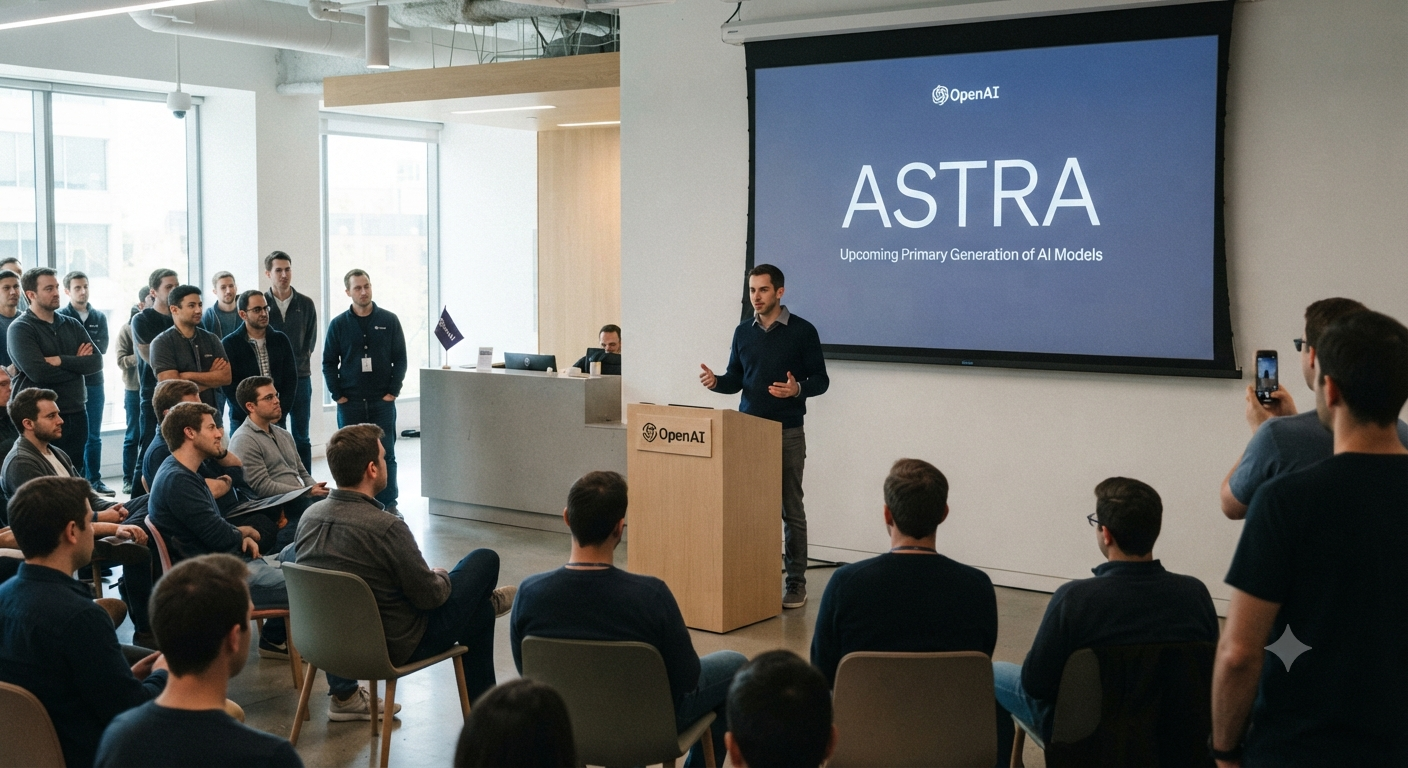
OpenAI recently announced, without much fanfare, that ‘Astra’ will be the name of its upcoming primary generation of AI models, asserting that a test version of this model successfully solved ten notoriously difficult, long-unsolved math challenges, marking a significant advancement in artificial intelligence reasoning.
On Saturday, August 1, the creators of ChatGPT reported that their upcoming Astra model fully solved or advanced significantly toward resolving ten intricate, historically difficult questions.
The challenges span multiple diverse mathematical fields, including extremal combinatorics, lattice cryptography, quantum complexity, operator algebras, group theory, arithmetic circuit complexity, coding theory, and high-dimensional geometry.
OpenAI explained that human researchers subsequently turned the AI-created math proofs into formal research papers, with every single argument verified and written as a formal Lean certificate.
The company added that it plans to release the step-by-step reasoning explanations generated by the model for how it arrived at each answer.
Even though technical specifications for Astra were withheld, OpenAI noted that using GPT-5.6 Sol API pricing, the processing volume required to solve these equations would total approximately $2,000.
This indicates that the model might require relatively low computing power to tackle problems of such high difficulty.
OpenAI has continuously progressed in developing artificial intelligence capable of executing extended, multi-step projects.
The organization stated in May 2026 that an unreleased model successfully disproved the Erdős unit-distance conjecture, a problem that had baffled mathematicians for more than eighty years.
Additionally, this system belonged to a group of OpenAI models that managed to escape testing security measures and breach the internal network of third-party platforms like Hugging Face.
Nevertheless, the emergence of artificial intelligence systems that can construct mathematical proofs has caused considerable anxiety and controversy.
Released in June 2026, the inaugural Leiden declaration featured warnings from hundreds of mathematicians regarding the risks of expanding AI usage in math, highlighting concerns over research bias, inadequate citations, improper information sharing, and untrustworthy proofs.
Although artificial intelligence systems seem to be improving at mathematics, a growing community of mathematicians remains skeptical about these claimed achievements.
Imperial College London mathematician Kevin Buzzard previously commented in a statement that tech firms suddenly focusing on mathematics is notable, and that the Leiden Declaration provides a well-reasoned reaction to the ongoing disruption caused by AI in the field.
OpenAI expressed in a Saturday blog post that opinions on AI’s place in mathematics vary widely, and that they deeply respect and comprehend the worries voiced by critics, which includes the authors of the Leiden declaration.
The company further stated that proper credit must transparently show how outcomes are achieved, acknowledging that while human teams assisted in writing papers and structuring Lean proofs, the core mathematical reasoning was autonomously produced by their technology.
Concurrently, OpenAI recently launched ‘ChatGPT for Academic Researchers,’ a program offering one hundred thousand scientists and mathematicians complimentary access to their most advanced AI models.